
1. Watch the video and answer the following questions:
a. What did you learn and gain from what you have just watch?
I’ve learned and gained that American accent is way easier than British accent but also British accent sounds cooler than American accent. And even they had different country, the words or dialects that they using has the same meaning. The difference between “British English” to “American English” is the pronoun citation of the words.
If you’re not a full time editor,you may be asking yourself what the differences between American and British English are. Well, American and the British clearly speak the same language, but there’s enough variation to create versions of the language with slightly different personalities and local flavor.
It’s difficult to make clear distinction between US and UK. A Texan and a New Yorker are both Americans, but have very different accents. The same goes for British accent in London, Manchester glasgow.
c. Answer the self assessment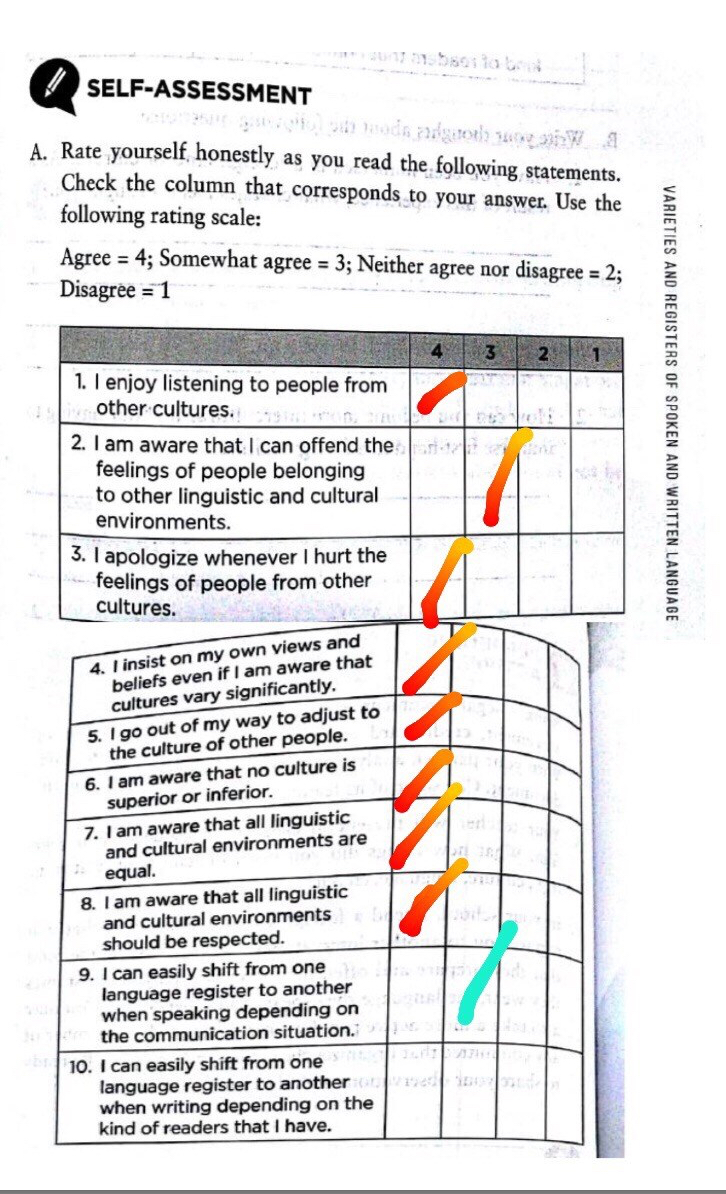
“Language Registers and Why it Matters?”
2. Give your view/opinions regarding the article you have just read.
A. Define language registers and how are these used.
Language register is the level of formality with which you speak. Different situations and people call for different registers. This is a concept I was talking about recently with some of my graduate students who dislike the idea of writing with a formal tone. They were commenting that they preferred to write in a conversational tone. Since our class is about learning to write up their academic research, I countered by saying that a manuscript submitted to a peer- reviewed journal was less likely to receive a favourable response from the editors if the tone was too conversational.
Some of themewere unfamiliar with the concept of language register, so I gave them a quick overview based on Joos’(1967) definitions:
https://drsaraheaton.wordpress.com
B. Give your view/opinion regarding the article you have just read.
Language register is so very important because to our society we need to understand each other. And imagine that your going to introduce to a very important person who you have never met. Maybe it is the mayor of your municipality. When you met him, would you say : Hey, dude! What’s up? Probably not. You would say something more formal such as “It is honor to met you”, instead you would be fine using the informal address, “dude”
3. Define Intercultural Communication
Intercultural communication is an implicit element of most language courses or features as an autonomous subject in other disciplinary fields. Where intercultural communication features as an autonomous subject the content is theoretically grounded in a specific discipline, e.g. anthropology, linguistics, philosophy and sociology. Alternatively, it is frequently linked to subjects like business studies, economics and tourism with the aim of providing students with the competence to operate in the professional sector concerned. In some cases it is taught not only as knowledge and a skill but also with the aim of promoting an appropriate attitude / awareness as an integrated part of language learning. Intercultural communication is sometimes associated with translation or with intercultural knowledge dissemination. In some business schools it is taught as part of business language degrees. In general, foreign language degree programmes do not offer courses in intercultural communication as such. Business schools and the business / economics faculties of universities offer a variety of courses on cultural theory and behaviour but many of these have no direct connection to languages at all. In the context of language learning the emphasis will be on the integration of intercultural communication and language learning.
1. Have you been immersed in a foreign land or culture? As a result of this experience, what change has it brought you. Yes, the changes I’ve experienced is that the way of living, language and belief that they have. It is hard to adapt their culture but if we really like it or we want to live or be with people. Of course we need to accept and adapt what they believe.
2. How can you become more intercultural without having to immerse first-hand in a foreign culture? We become more intercultural without having to immerse by knowing accepting and respecting their beliefs and how they live.
3. Has there been a time when you have offended someone of a different linguistic and cultural background? What was the situation? How was the conflict resolved? Yes, it is when I have my schoolmate that is from ilo-ilo. Her language is different from us that’s why I always bully her and I got her angry. I realized that it is not good to bully her because of her language and I need to respect that as a person.
4. What factors can increase your effectiveness in communicating with people from other cultures? The factors that I need to increase to have an effective communication are having respect, being kind, accepting there culture and beliefs and knowing your limitation in communicating with others.
5. Using the scale below, how would you rate yourself as an intercultural communicator? Why? Excellent = 4; Good = 3; Fair = 2; Poor = 1. I can rate myself as Good = 3; because of what I have as a good communicator and I will improve my characters that I need to have.

 Jeren's BLOG